#46
Palladium
transition metal· Solid·106.421 u
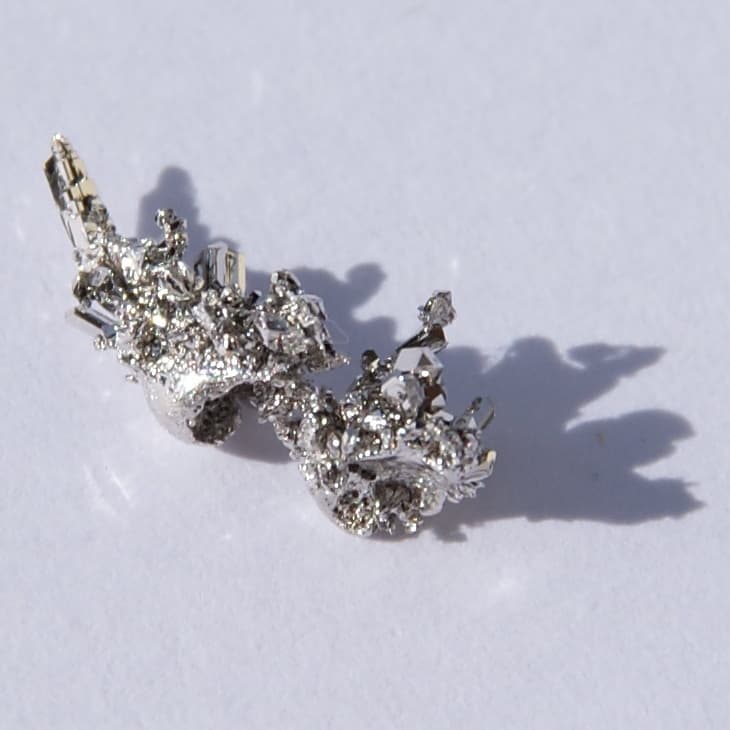
Palladium is a chemical element with symbol Pd and atomic number 46. It is a rare and lustrous silvery-white metal discovered in 1803 by William Hyde Wollaston. He named it after the asteroid Pallas, which was itself named after the epithet of the Greek goddess Athena, acquired by her when she slew Pallas.
Read on Wikipedia
Identity
- Symbol
- Pd
- Atomic Number
- 46
- Atomic Mass
- 106.421 u
- Category
- transition metal
- Block
- d-block
- Period
- 5
- Group
- 10
- Appearance
- silvery white
- Year Discovered
- 1803 CE
- Discovered By
- William Hyde Wollaston
- Named By
- 2 Pallas
Electrons
- Configuration
- [Kr] 4d10
- Full Configuration
- 1s2 2s2 2p6 3s2 3p6 4s2 3d10 4p6 4d10
- Shells
- 2, 8, 18, 18
- Electronegativity
- 2.2
- Electron Affinity
- 54.24
- Oxidation States
- +3, +2
- Ionization Energies
- 804.4, 1870, 3177
Physical Properties
- State at
- Solid
- Melting Point
- 1828.05
- Boiling Point
- 3236
- Density
- 12.023
- Molar Heat
- 25.98 J/(mol·K)
- Crystal Structure
- FCC
- Magnetic Ordering
- Paramagnetic
Mechanical
- Atomic Radius
- 169 pm
- Covalent Radius
- 139 pm
- Van der Waals
- 202 pm
- Metallic Radius
- 137 pm
- Mohs Hardness
- 4.75
- Brinell Hardness
- 37.3 MPa MPa
- Vickers Hardness
- 461 MPa MPa
- Bulk Modulus
- 180 GPa GPa
- Shear Modulus
- 44 GPa GPa
- Young's Modulus
- 121 GPa GPa
Thermal & Electrical
- Thermal Conductivity
- 71.8 W/(m K) W/(m·K)
- Electrical Conductivity
- 10 MS/m S/m
- Specific Heat
- 244 J/(kg K) J/(g·K)
- Heat of Vaporization
- 357 kJ/mol kJ/mol
- Heat of Fusion
- 16.7 kJ/mol kJ/mol
Abundance
- Universe
- 2.00 ppb
- Sun
- 3.00 ppb
- Meteorite
- 560 ppb
- Earth's Crust
- 15.0 ppb
- Ocean
- 6.3 ppt
- Human Body
- 0