#50
Tin
post-transition metal· Solid·118.7107 u
Tin is a chemical element with the symbol Sn (for Latin:stannum) and atomic number 50. It is a main group metal in group 14 of the periodic table. Tin shows a chemical similarity to both neighboring group-14 elements, germanium and lead, and has two possible oxidation states, +2 and the slightly more stable +4.
Read on Wikipedia
Identity
- Symbol
- Sn
- Atomic Number
- 50
- Atomic Mass
- 118.7107 u
- Category
- post-transition metal
- Block
- p-block
- Period
- 5
- Group
- 14
- Appearance
- silvery-white (beta, β) or gray (alpha, α)
- Year Discovered
- Ancient
- Discovered By
- unknown, before 3500 BC
Electrons
- Configuration
- [Kr] 4d10 5s2 5p2
- Full Configuration
- 1s2 2s2 2p6 3s2 3p6 4s2 3d10 4p6 5s2 4d10 5p2
- Shells
- 2, 8, 18, 18, 4
- Electronegativity
- 1.96
- Electron Affinity
- 107.2984
- Oxidation States
- +4, +2
- Ionization Energies
- 708.6, 1411.8, 2943, 3930.3, 7456
Physical Properties
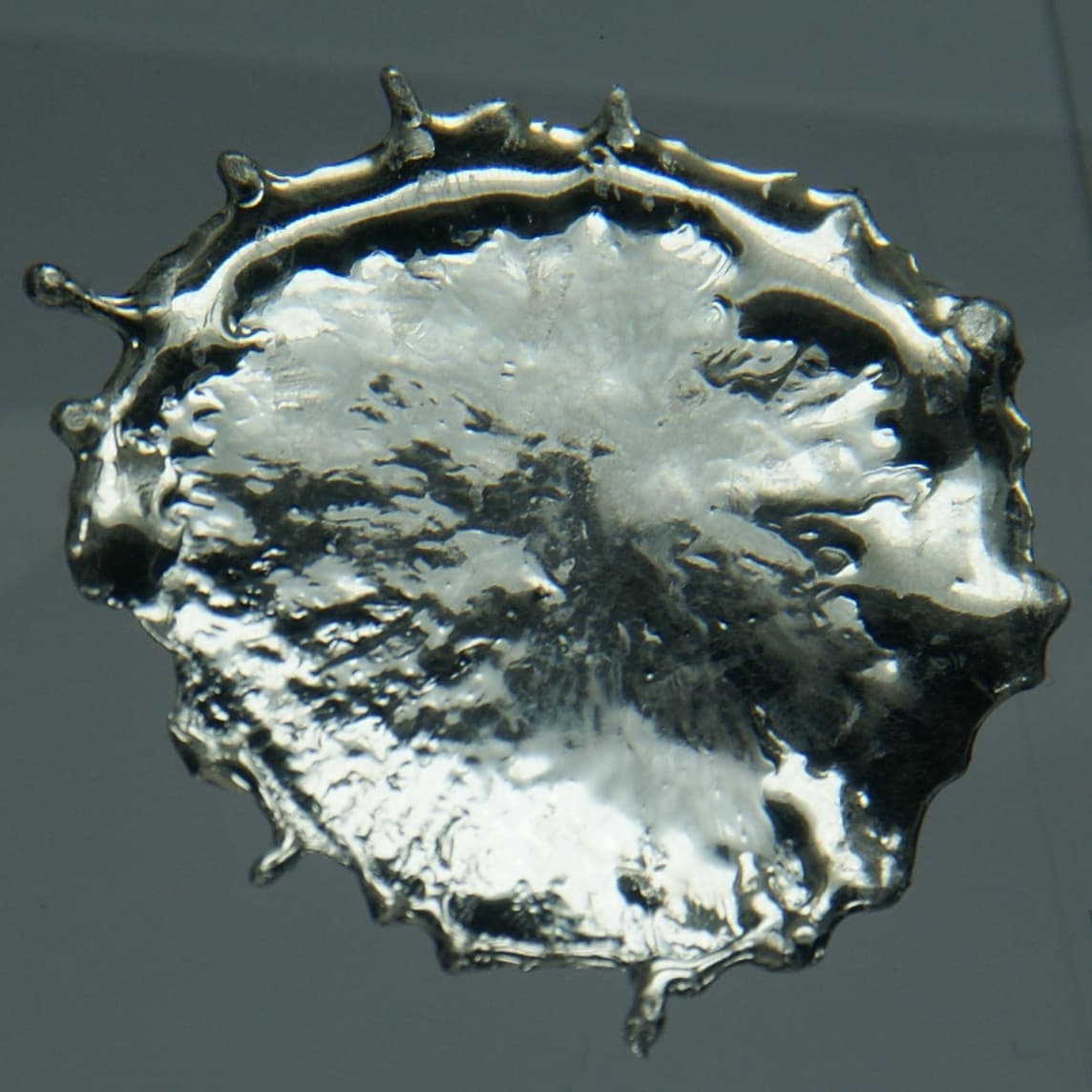
- State at
- Solid
- Melting Point
- 505.08
- Boiling Point
- 2875
- Density
- 7.365
- Molar Heat
- 27.112 J/(mol·K)
- Crystal Structure
- Tetragonal
- Magnetic Ordering
- Diamagnetic
Mechanical
- Atomic Radius
- 145 pm
- Covalent Radius
- 139 pm
- Van der Waals
- 217 pm
- Metallic Radius
- 140 pm
- Mohs Hardness
- 1.5
- Brinell Hardness
- 51 MPa MPa
- Vickers Hardness
- 51 MPa MPa
- Bulk Modulus
- 58 GPa GPa
- Shear Modulus
- 18 GPa GPa
- Young's Modulus
- 50 GPa GPa
Thermal & Electrical
- Thermal Conductivity
- 66.8 W/(m K) W/(m·K)
- Electrical Conductivity
- 9.17 MS/m S/m
- Specific Heat
- 228 J/(kg K) J/(g·K)
- Heat of Vaporization
- 296 kJ/mol kJ/mol
- Heat of Fusion
- 7.03 kJ/mol kJ/mol
Abundance
- Universe
- 4.00 ppb
- Sun
- 9.00 ppb
- Meteorite
- 910 ppb
- Earth's Crust
- 7.28 ppm
- Ocean
- 4.00 ppt
- Human Body
- 200 ppb